
Long-distance video calls with your child: a guide by age, 0–8
In short. What matters most in a long-distance call with your child is not how long it lasts or the screen itself, but how you respond to what your child does. Call briefly and often, at the same time each day, and ask the adult next to your child to help. The younger the child, the more the call should feel like a game rather than a conversation.
You moved away, you work on rotation, you live apart after a separation, or you are a grandparent in another city. Often the call is the main way to be close. But a call with a one-year-old looks nothing like a call with a seven-year-old. Below is the general principle, a table by age and links to detailed articles on each topic.
What matters most in a long-distance call with your child
Responding to your child matters more than the screen itself.
- The American Academy of Pediatrics (AAP) calls a toddler's video call with loved ones "relationship time," not screen time (AAP, 2026). What AAP and WHO say, in detail, is in the article “Video calls are not screen time”.
- Children aged 2–2.5 learned new verbs in a live video chat where the adult responded to them, but not from a recording of the same conversation (Child Development, 2014).
- In infants on calls with their grandmother, positive emotions were predicted by the grandmother's sensitivity, not by whether it was video or an in-person visit (Infancy, 2022).
Call often, even if briefly. In a survey of 855 grandparents and 846 parents of children aged 0–5, a grandparent's closeness to a grandchild was most strongly linked to how often they called, and also to how varied the activities on the call were (Strouse et al., 2021). This is a correlation, not a proven cause. The same review cites a survey known from a conference talk: two thirds of parents of toddlers aged 16–30 months said their child talks on video for less than five minutes (why that happens and what to do about it).
The adult next to your child is your co-author. AAP advises them to point at the screen and name what is happening there. In a study cited by Strouse and colleagues, an infant's attention was higher when the whole family was looking at the same thing — for example, when the parent nearby brought toys to the screen.
On video, little ones play more than on the phone. Children aged 2–3.5 played more and showed more joy on a video call with a parent than on an ordinary audio call (Frontiers in Psychology, 2013).
How long a call with your child lasts, by age
The minutes in the table are a rough guide from practice, not an AAP or WHO norm. Neither AAP nor WHO sets a length for video calls, and there is no direct research on "how many minutes is best." The ranges come from a review of practices for organizing calls with young children; it has no separate range for ages 6–8, so that row extends the guide for ages 4–6.
| Age | What to expect | What to do | Length (a guide, not a norm) |
|---|---|---|---|
| 0–1 year | Looks at the screen for less than half the call, reacts to voice and face | Peekaboo, a song, repeat the baby's sounds | 2–7 minutes |
| 1–2 years | Walks, runs off, brings things; by 18–24 months starts to understand that the person on screen is real | "Show me," games with movement, follow the child with the phone | 3–8 minutes |
| 2–3 years | Plays and shows things; plays and shows more joy on video than on the phone | A simple game, "find one just like it," a book | 5–15 minutes |
| 3–5 years | Understands that you are in another place; loves a storyline and choices | A shared story, a drawing, a game with turns | 5–15 minutes, from age 4: 10–20 |
| 5–8 years | Can hold a conversation, but drifts in and out of it | A shared project, a game with rules, let them read to you | 10–20 minutes, longer with an engaging task |
If your child played with you happily for two minutes and then finished on their own, that was a good call. If you spent twenty minutes coaxing them back to the screen, it wasn't.
Calling a baby under 1
- Babies look at the screen about 41% of the call, and their attention to the call grows with age and experience (AAP). If your baby gets distracted, don't be discouraged: that is normal.
- Repeated rituals help: for example, the same song at the start and the same "bye-bye" at the end.
- There is a separate article for grandparents: “Grandparents and grandkids on video calls”.
Calling a 1–2-year-old
- Your child may run away from the call — that is the age, not how they feel about you. What to do about it is in the article “Toddler runs away from video calls”.
- The review by Strouse and colleagues cites data showing that by 21–25 months children can recognize people they have only talked to on video, even if the calls were infrequent (Strouse et al., 2021).
- A ready five-minute plan is in the article “Video calls with a 1–2 year old: a 5-minute script”.
- At this age the adult nearby is especially important: “How the adult next to your child makes a video call better”.
Calling a 2–3-year-old
- Action instead of questions: "show me," "find," "let's do it together." Phrases children actually respond to are in the article “What to say to your child on a video call”.
- You can read together, and without any special questioning technique: in an experiment with children aged 2.5–3 (not on video), the technique added no language gains beyond ordinary active shared reading (JSLHR, 2020). How to set this up on video is in the article “How to read to your child over a video call”.
- Give a heads-up before the call ends and always say goodbye the same way: “How to end a video call without tears”.
Calling a 3–5-year-old
- According to data cited by Strouse and colleagues, by 3–4 years children understand that the person on screen is in another place. You can show your home, your window, your cat.
- Offer choices: "dinosaur or book?", "who's in charge today — your bunny or mine?"
- Make up a story taking turns and continue it next time — that way your calls get their own storyline.
- The connection will freeze. What to say so your child doesn't get scared is in the article “Video call froze? What to tell your child”.
Calling a 5–8-year-old
- Your child can already hold a conversation, but a shared activity works better: a game with rules, a drawing, a project.
- Let your school-age child read aloud to you while you listen: “Let your child read to you”.
- Instead of "how are you?", ask something specific: "Did anything funny happen today? And anything not so nice?"
Common mistakes
- Interrogation. "What did you do? What did you eat? Where did you go?" A small child finds these questions hard to answer. More in 12 phrases instead of “how are you?”.
- Keeping them at the screen. Coaxing them back turns the call into a chore. Better to follow your child with the phone.
- A call with no ending. It is easier for a child when the goodbye is always the same and the next call is clear: "I'll call after dinner."
- TV in the background. AAP explicitly advises keeping it off during the call.
- Adult conversations in front of the child. Schedules, money and complaints are better discussed outside the child's call. More in “Calling your child after divorce”.
- Panicking when the call glitches. AAP advises calmly explaining to your child what is happening.
How laketa works
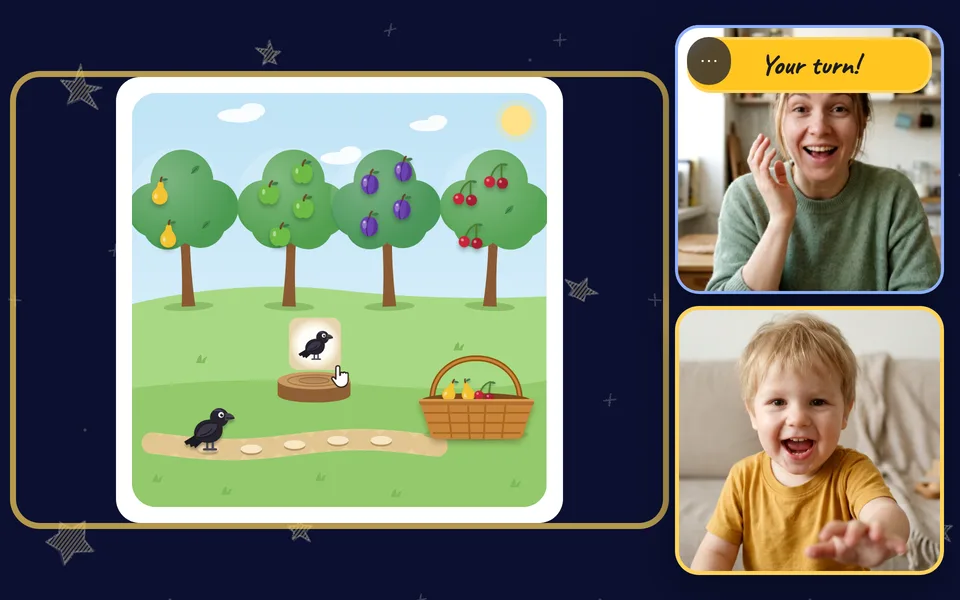
I'm building laketa for parents and grandparents who call children from far away. The child joins through one permanent link, with no app and no sign-up. On the call you can draw and color together, and there are games for different ages: Orchard for little ones, Trains, Maze, Tic-tac-toe and Checkers for older kids. There are no videos, feeds or ads.
Sources accessed 2026-10-09. This article is not a substitute for advice from a pediatrician or psychologist.
Frequently asked questions
- How long should a video call with a child last?
- There is no norm: neither AAP nor WHO sets a length for video calls. A guide from practice: a few minutes for toddlers under 2, 5–15 minutes at ages 2–4 and 10–20 minutes from age 4, longer with an engaging shared activity.
- How often should I call my child if we live apart?
- There is no strict norm. In a large survey, grandparents' closeness with their grandchildren was most strongly linked to how often they called, so short, frequent calls at the same time are a good option.
- Can I video call a baby under one?
- WHO does not recommend screen time for children under 1, but its examples of screen time are cartoons and video games, and it says nothing about video calls. The American Academy of Pediatrics calls a video call with loved ones relationship time, not screen time.
- What should I talk about with my child on a video call?
- The younger the child, the fewer questions and the more actions: peekaboo, a song, “show me,” a shared game or drawing. A school-age child can read aloud to you or play a game with rules with you.