
Video calls with a 1–2 year old: a 5-minute script and phrases
In short. A video call with a 1- to 2-year-old works well in four steps: a familiar greeting, joining in with whatever your child is doing, one or two simple activities (peekaboo, a song, "show me"), and the same goodbye every time. Five minutes is a guideline, not a norm. What matters most is responding to what your child does, not following your own plan for the conversation.
An adult-style conversation with a one-year-old doesn't work: they won't answer "how are you?", and a minute later they're off to their toys. That doesn't mean it's too early to call. What you need is not a conversation but a short game with a clear beginning and end. Below is a ready-made script with phrases.
How long should a video call with a 1- to 2-year-old last
Shorter than you think. In a review of video chat research, Strouse and colleagues cite a survey of parents of children aged 16–30 months (Myers and McKenney, 2021): two thirds said their child talked on video for less than 5 minutes, and half of the children sometimes ran off in the middle of a call (Strouse et al., 2021). This is a conference talk, not a large study, but the picture is easy to recognize.
So the script below is designed for about 5 minutes. If your child has had enough after two and walks away, the call still worked. If they want to keep playing, keep going. This is a guideline, not a norm. More on why toddlers leave the frame in “Toddler runs away from video calls”.
Why responding to your child matters more than entertaining them
In an experiment by Roseberry, Hirsh-Pasek and Golinkoff (2014), children aged 24–30 months — a little older than yours — learned new verbs when an adult talked with them over live video chat and responded to them. From a recording of the same conversation, they did not (Child Development, 2014).
The American Academy of Pediatrics (AAP) says something similar: toddlers can learn new words over video chat with an adult who smiles, responds and builds on what the child said (AAP, 2026).
That gives you a simple rule for the call: your child did something — you noticed exactly that and responded. The more of these short exchanges, the better, even if the call lasts three minutes. To a child, an entertaining story with no pauses feels more like a recording than a conversation.
One more observation from the AAP: infants look at the screen about 41% of the time during a call. A child looking past the screen is not ignoring you. According to the AAP, attention to video calls grows with age and with experience of such calls.
A 5-minute call script
The order of the steps comes from practice, not research. The activities are the ones the AAP recommends: peekaboo, toys, songs, dancing, games. In the examples, dad is calling — put yourself in: mom, grandma, grandpa.
| Time | What to do | What to say |
|---|---|---|
| 0:00–0:30 | The same greeting every time | "Hi, Sam! It's Daddy. I can see you" |
| 0:30–1:30 | Join in with what your child is doing | "You found a spoon! I have a spoon too" |
| 1:30–4:00 | One or two activities | "Peekaboo! Where's Daddy?… Here's Daddy!" |
| 4:00–5:00 | Give a heads-up and say goodbye the same way | "Now our song, and then bye-bye" |
The greeting: the same every time
Pick one phrase, gesture or line from a song and repeat it at the start of every call. "Hi, Sam! It's Daddy. I can see you" — and wave. The AAP writes that a predictable routine helps a child (it's talking about a regular time for the call). A familiar opening is a way to make the call itself predictable; this is advice from practice.
Join in with what your child is doing
Don't call them over to the screen — join in with whatever is already in their hands. Describe instead of asking:
- your child says "Beep-beep!" — "Yes, beep-beep! The red car is driving: beeeep!";
- shows you the cat — "You showed me the cat! Hi, kitty";
- instead of "What color is the car?" — "Oh, you have a red car. Mine is blue. Let's go!"
Repeat your child's word and add one or two more. This is not a test — your child doesn't need to give any right answers.
One or two activities
No more than two — and switch if one doesn't land. Options that need very few words from your child:
- Peekaboo. Cover your face with your hands or a toy: "Where's Daddy?… Peekaboo!" Repeat two or three times, then let your child hide.
- A song with hand motions. The same short song or nursery rhyme with clapping, like "Pat-a-cake": "I'm clapping — clap, clap. Now you?"
- "Show me." "Show me one thing you played with today." Whatever they bring — name it, be surprised, show yours.
- The same object on both sides. A ball, a spoon, a teddy bear: "I have a ball. Where's your ball?" You can arrange with the adult next to your child to keep such an object nearby.
If you don't know what to pick, offer a choice of two: "Ball or teddy?" That's easier than "What do you want to play?"
The goodbye: the same, and with a heads-up
Give a heads-up half a minute ahead: "Now our song, and then bye-bye." Then always the same order, for example: a song, a blown kiss, "bye-bye, I'll call after breakfast." End the call yourself while your child is still interested. How to end a call without tears is in a separate article: “How to end a video call without tears”.
If your child leaves the frame in the second minute
That's normal. Don't coax them back — ask the adult next to them to turn the phone toward where your child is, and describe what you see. If the song didn't work, move on to an object; if the object didn't work, move on to movement. If nothing catches on, go straight to the goodbye: a short call with a good ending is better than a long one full of coaxing.
Why the adult next to your child matters so much at this age
At around 18–24 months a child only begins to understand that the face on the screen is a real person, the AAP writes. At first a toddler may think you live "inside the phone." This passes with repetition, and it helps if you show where you are: your room, your window, your cat.
Until your child understands this, a lot depends on the adult next to them. The AAP advises that adult to point at the screen and describe what is happening there: "Look, Daddy's holding a ball!" What else that adult can do is in “How the adult next to your child makes a video call better”.
If there is another adult with your child when you call, agree on three things: call at the same time each day, turn off the background TV (both are direct AAP advice), and keep one toy handy for your game.
How laketa works
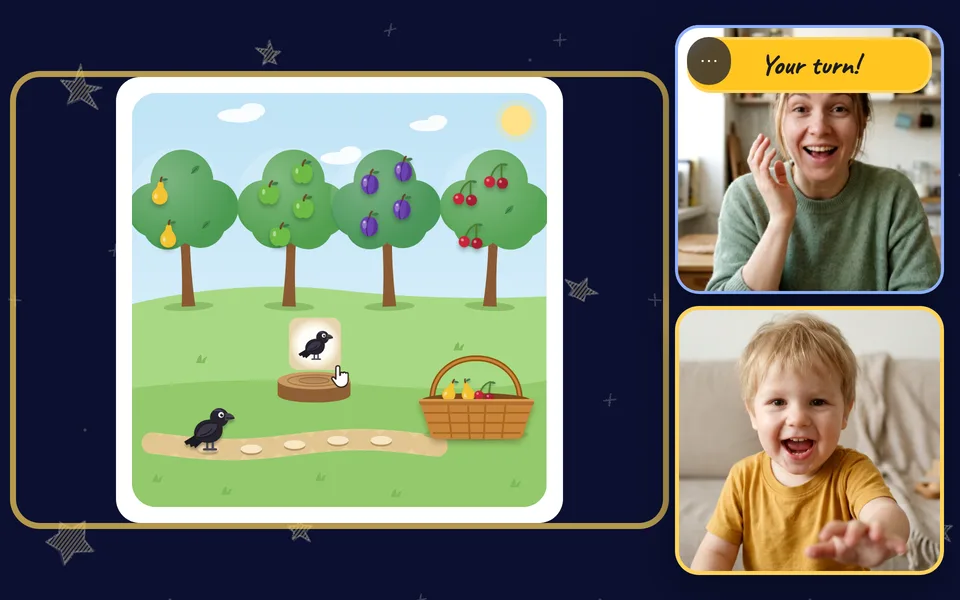
I'm building laketa for parents who call their children from far away. Your child opens one permanent link, no app and no sign-up, and joins a call with no videos, no feed and no ads. With a toddler you can draw together, and from age two you can play a simple game called Orchard. At the end of the call you can launch confetti or balloons — it's easy to make that part of your goodbye.
Sources accessed 2026-10-09. This article is not a substitute for advice from a pediatrician or psychologist.
Frequently asked questions
- How long should a video call with a 1- to 2-year-old last?
- Usually a few minutes. In a survey of parents of children aged 16–30 months, two thirds said their child talked on video for less than 5 minutes. Five minutes is a guideline, not a norm.
- What do I talk about with a one-year-old on a video call?
- Rather than asking questions, describe what your child is doing: "You found a spoon! I have a spoon too." Peekaboo, a song with hand motions and "show me" all work well.
- Does a 1- to 2-year-old understand who is talking to them on video?
- According to the AAP, at around 18–24 months a child begins to understand that the face on the screen is a real person. Until then, the adult next to the child who points at the screen and describes what is happening matters most.
- What if my toddler runs away during the call?
- Don't coax them back; ask the adult next to them to turn the phone toward your child and describe what they're doing. If nothing catches on, it's better to calmly say goodbye.