
Grandparents and grandkids on video calls: make it a tradition
In short. In a study of babies, what predicted a baby's joy on a call was how warmly and attentively the grandmother responded to the baby's cues — not the format, video or in person. In a large survey of grandparents, closeness with a grandchild was linked to how often the family calls and how varied the activities on the call are. The length of calls was not measured in that survey.
Grandma waits all week for the call, and a minute in, the grandchild crawls off after the cat. Or looks past the screen, or chews on the phone. It's easy to decide that “video just isn't the same.” Research on family video calls says otherwise, and you can build a simple tradition from it.
Can grandparents video call a grandchild who is still very little
Yes, and studies of babies support it.
- In a study by Roche and colleagues (2022), 48 families recorded video calls between a grandmother and a baby, and most also recorded a visit in person. The babies were around 10 months old on average at the first call; on the older side, only grandmothers took part. The baby's positive emotions were predicted only by the grandmother's sensitivity — warmth and responsiveness to the child's cues. Not the format (video or in person), and not other factors (Infancy, 2022).
- In a study by Neely and colleagues (2026), 47 families with babies around one year old recorded calls and a visit in person. Grandmothers and babies played over video in all sorts of ways — from dancing to peekaboo — and the variety of play over video turned out to be even greater than in person. Play was predicted most strongly by age: the older the baby, the more varied the games and the more often the baby started them. But even the youngest played (Infancy, 2026).
Both studies are small, the families are from the US and Canada, and in the first one they are mostly highly educated. But the takeaway is clear: you don't need to wait until your grandchild “grows into the phone.”
Don't worry if the baby looks away. According to the American Academy of Pediatrics (AAP), babies look at the screen about 41% of the time during a call (AAP, 2026). That's normal.
What makes calls with grandchildren warmer
In the summer of 2020, Strouse, McClure, Myers, Zosh and colleagues surveyed 855 grandparents and 846 parents of children aged 0–5 (Strouse et al., 2021). What they found:
- closeness between grandparent and grandchild was most strongly linked to how often they call — even after accounting for how far apart the families live;
- another link was the variety of activities on the call: smiling, waving, showing things from your home, singing, reading;
- frequency and variety were also linked to how much grandparents and parents enjoy the calls;
- the share of time the adults talked to each other rather than to the child was not linked to closeness;
- the type of device (phone or computer) and technical glitches were not linked to closeness either.
This is a survey, not an experiment: it shows a link, not proof that frequent calls create closeness by themselves. AAP cites the same finding: grandparents felt closer to their grandchildren when there were more video calls.
How to make calls your own tradition
The tips below are from practice. Where there is research behind them, the link is right there.
- Your own song or rhyme. The same one at the start or end of every call: “Pat-a-cake,” “This Little Piggy,” your family song. The authors of the 2026 study suggest that doing the same thing on a call and in person — for example, always waving goodbye or singing a favorite song — helps a baby connect the grandma on the screen with the real grandma.
- Your own “go-between” toy. A teddy or bunny that lives at Grandma's and shows up on every call: says hello, hides, “eats” together with the baby. This is advice from practice, not a research finding.
- A regular time. After breakfast, before the nap — whenever suits the family. AAP advises a regular time and tying the call to something familiar: a meal, a book, a toy.
- Short and often. With toddlers, a video chat is often shorter than five minutes — more on that in “Toddler runs away from video calls”. Call length wasn't measured in the grandparent survey, and frequency had the strongest link to closeness. So the advice from practice: a few short calls a week are easier than one long one.
- Switch activities. Peekaboo, “let's eat together” (you bite an apple, the baby bites theirs), a song, showing the cat or the window. In a study cited by Strouse and colleagues, a baby's attention was linked to the grandmother's sensitivity — how she tuned in to the child in warm games like these. AAP adds: when a grandparent shows their home, it's easier for the baby to understand that they are in a different but real place.
- Ask the parents what's new. Started walking, fell in love with tractors, is afraid of the vacuum cleaner — that makes it easier to start talking. The Strouse review cites an observation: grandmothers who talked more with the parents themselves talked longer and more often with their grandchildren — they knew what to ask about.
The adult next to the grandchild is half the success
If you are the grown son or daughter, a lot depends on you. In the Strouse survey, during a call parents most often asked the child questions (78%) and pointed at the screen (73%), and more than half hugged and tickled the child “from Grandma.” AAP advises the adult next to the child to point at the screen and name what's happening there. More in “How the adult next to your child makes a video call better”.
Neely and colleagues give a good example from an earlier observation of families: a grandmother sings a finger rhyme over video while the mother plays with the baby's toes (Infancy, 2026). The call becomes a shared game for two adults and one child.
How to make the technology easier for Grandma
This is advice from practice, not research.
- One phone or tablet and one way to call. The less choice, the fewer mistakes.
- A stand so the phone doesn't have to be held, and a charger nearby.
- The first call is a trial run, together with the grown son or daughter. You can write the instructions down on paper in large print.
- Agree on who calls whom and when.
There will be glitches anyway. In the survey, 42% of grandparents had run into the picture or sound freezing, but glitches were not linked to closeness. AAP advises explaining to the child what's happening when that happens. Ready-made phrases are in “Video call froze? What to tell your child”.
If you feel sad after a call
Many people know this feeling. In the same survey, 40% of grandparents said calls remind them how much they are missing. Emotional difficulties with calls overall were linked to less closeness and less enjoyment of the calls. Advice from practice: notice not what's missing but what worked. Today your grandchild laughed at “peekaboo” and showed you their toy car.
How laketa works
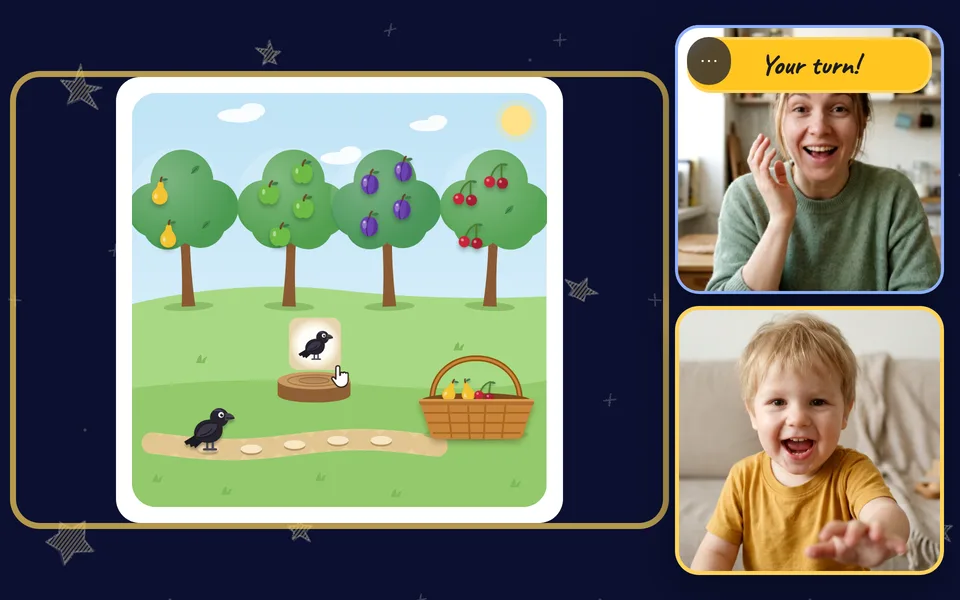
I'm building laketa for families where adults call children from far away, grandparents included. The grandchild joins through one permanent link, with no app and no sign-up. The person calling needs to sign in by email to create a room for the call — the first time, that's easier to do together with the grown son or daughter. On the call you can draw together and play simple games, and there are no videos, feeds or ads.
Sources accessed 2026-10-09. This article is not a substitute for advice from a pediatrician or psychologist.
Frequently asked questions
- How can a grandmother connect with a very young grandchild over video?
- Respond to what the baby does: smile, wave, play peekaboo, sing the same song. In a study of babies, their positive emotions were predicted by the grandmother's sensitivity, not by whether it was video or in person.
- How often should grandparents video call their grandchildren?
- There is no strict rule. In a survey of 855 grandparents, closeness with a grandchild was most strongly linked to how often they call. Advice from practice: a few short calls a week are easier than one long one.
- Can a child bond with a grandparent over video calls?
- There is no direct data on a child's attachment. In the survey, grandparents felt closer to their grandchildren when there were more calls and the activities on them were more varied. That is a link, not a proven cause.
- What if the baby doesn't look at Grandma on the screen?
- That's normal: according to the American Academy of Pediatrics, babies look at the screen about 41% of the time during a call. It helps when the adult next to the baby points at the screen, brings toys and names what is happening.
- How can I make video calls easier for an older person?
- One phone or tablet and one way to call, a stand and a charger nearby, and a first trial call together with their grown son or daughter. This is advice from practice.