
Calling your child after divorce: what to talk about and what not to
In short. A call with your child is your child's time. It is not the place to sort out the schedule, money or complaints about the other parent, or to question your child about life in the other home. Adults settle adult matters in a separate conversation between adults. What helps a child is predictable calls, kept promises and talking about the child.
If you live apart from your child after a divorce or separation, the call may be the main thing you have together. And that is exactly where everything adult can break through: resentment, tiredness, unsettled issues with the other parent. This article is about how to keep the call for your child.
Contact with a child is arranged by agreement between the parents or by a court. This article is not about that and is not a substitute for legal advice. If there is violence in the family or contact is restricted, safety and the established arrangement come first, not the advice below.
What not to discuss in front of your child on a call
A child cannot refuse to listen to an adult conversation and cannot change anything in it. So these topics are better moved out of the call and into messages between the adults.
| Topic | How it sounds on a call | Where to move it |
|---|---|---|
| Visiting schedule | “Tell Mom I can't make it on Saturday” | Messages between adults |
| Money and purchases | “So where did the jacket money go?” | Messages between adults |
| Complaints about the other parent | “They didn't put you to bed on time again” | A talk between adults, without the child |
| The adults' relationship | “It's not my fault we live apart” | Not with the child |
| New partners | “Who's that man at your place?” | A talk between adults, without the child |
Don't count on a small child "not understanding anyway." Even if he doesn't understand the words, he can pick up the tension in your voice.
Don't make your child the messenger
“Tell Dad to call me back,” “Tell Mom I'll pick you up on Friday” — for an adult it's a small thing; for a child it's an errand that puts him between two people he loves. If the message doesn't get through or lands badly, the child may decide it's his fault.
Whatever the other adult needs to know, tell them yourself — by message, in a separate call, through the app you agreed on. On a call with your child, you have no messages for anyone else.
Don't question your child about life in the other home
Questions like “Did Mom come home late again?”, “Who was over at your place?” or “Do they scold you there?” turn a child into an informant. Even if you ask out of worry, the child may feel that his answers are being used against the other parent.
Ask about him and about what he can show you:
- “Show me what you built today.”
- “What was the funniest thing at daycare?”
- “Will you draw me where you went for a walk?”
More questions a child is happy to answer are in “What to say to your child on a video call”.
If you are genuinely worried about his safety or health, that is a question for adults and professionals, not for your child on a call.
Don't ask your child to pick a side
“Who do you like living with better?”, “You want to come to me, right?”, “Is that allowed at Mom's?” — a child loves both parents, and any answer to a question like that is a losing one for him. It helps when the child hears the opposite from you: that loving the other parent is fine. For example: “How great that you and Dad went to the park.”
Your sadness is not his job
Missing your child is normal, and it's fine to tell him you miss him. But phrases like “I feel so bad without you,” “I'm so lonely here,” or tears at the end of the call shift the job of looking after an adult onto the child. He may start comforting you, and later feel guilty that he is happy in the other home.
Better:
- “I miss you. It's so good to see you.”
- “I loved hearing about your day.”
- “I'll call tomorrow after dinner. Bye-bye!”
If things are really hard for you, talk about it with adults — friends, family, a therapist — but not with your child.
How to make calls predictable
It's easier for a child when calls happen at the same time and follow a familiar pattern.
- Agree on the time with the other adult in advance — in your separate messages, not at the start of the call in front of the child.
- Start the same way. The same greeting, song or gesture.
- Give your child something to do. Show a toy, draw together, play a simple game — that's better than an interrogation about his day.
- End the same way and on time. The same goodbye phrase and a promise of the next call. How to do that without tears is in “How to end a video call without tears”.
Only promise what you will do
“I'll call tomorrow” — and you call tomorrow. For a child who lives apart from you, a kept promise about the next call can mean more than a long conversation.
- Use a marker your child understands: “after daycare,” “before bed,” not “one of these days.”
- Don't promise visits, trips or presents on the call that you haven't agreed on with the other adult yet. If the plan falls through, the child will be disappointed, and the other parent will end up as “the one who said no.”
- If you can't make a call, let the other adult know in advance, and on the next call tell your child: “I couldn't call on Thursday. I think about you all the time.”
If a call does turn into an argument
It happens. If an adult conversation starts in front of your child, stop: “Let's talk about this later.” Go back to your child or end the call calmly. Next time you can tell your child: “Yesterday the grown-ups spoke sharply. It wasn't your fault at all.”
How laketa works
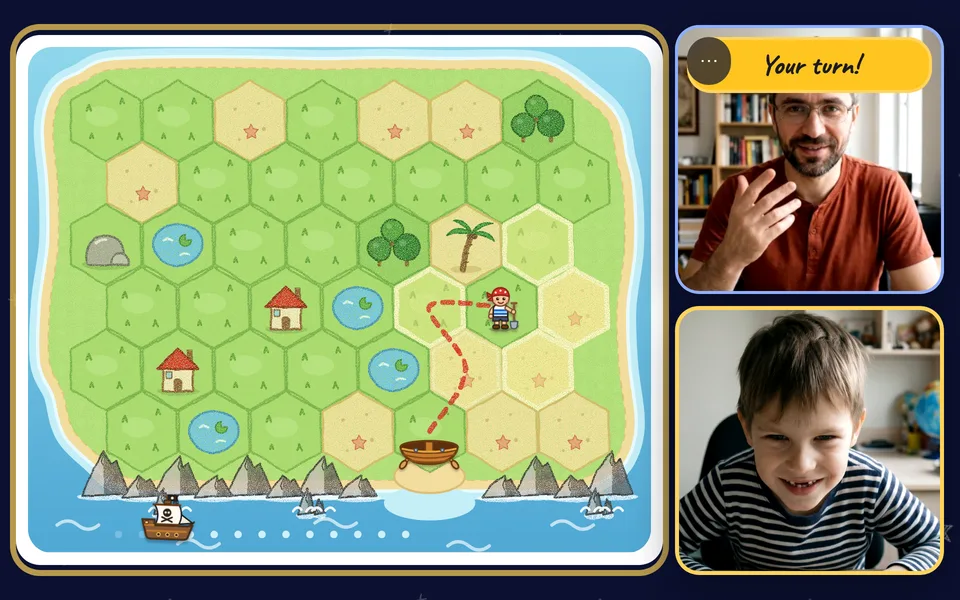
I'm building laketa for parents who live apart from their children. The child joins the call through one permanent link, with no app and no sign-up, so the other adult only needs to save it once. On the call you can draw together and play simple games — that makes it easier to keep the conversation on what interests the child.
This article is not a substitute for advice from a pediatrician or psychologist.
Frequently asked questions
- What should I talk about with my child on the phone after a divorce?
- About your child: what they built or drew, what was funny today. Giving your child something to do — showing a toy, drawing together — works better than asking questions.
- Can I discuss the schedule with my ex in front of the child during a call?
- Better not. Move the schedule, money and complaints into separate messages between the adults, and keep the call for your child.
- Can I ask my child to pass something on to the other parent?
- Better not: it puts the child in the middle, as a messenger between two people they love. Whatever the other adult needs to know, tell them yourself.
- Is it okay to tell my child I miss them?
- Yes, telling your child you miss them is fine. But don't hand them your sadness with phrases like “I feel so bad without you” — looking after an adult is not their job.
- How can I make calls with my child after a divorce regular?
- There is no strict rule. Predictability matters more: the same time, a familiar start and end, and a kept promise about the next call.