
Toddler runs away from video calls? Why, and what helps
In short. In a survey of parents of children aged 16–30 months, two thirds said their child talks on video for less than 5 minutes, and half said the child sometimes just runs away from the call. This is normal behavior for the age, not a sign of how your child feels about you. In research, a toddler's attention is linked to how well the adult on the screen tunes in to the child.
You waited all day for the call, and two minutes in, all you can see is the ceiling and someone's heel. Your child ran off to the toy cars, and you're talking to an empty room again. Almost everyone who calls a toddler from far away knows this.
Why toddlers run away from video calls
Researchers who study video chat with young children describe the same behavior again and again. Strouse, McClure, Myers, Zosh and colleagues gathered data from several studies in a 2021 review (Strouse et al., 2021):
- in a survey of parents of children aged 16–30 months (Myers and McKenney, 2021), two thirds said the conversation lasted less than 5 minutes, and half of the children sometimes ran off in the middle of a call;
- toddlers under 25 months who already walk often move around the room during a video call (McClure and Barr, 2017);
- children aged 3–10 drift in and out of the adults' conversation and come back (Forghani and Neustaedter, 2014).
The American Academy of Pediatrics adds that infants look at the screen about 41% of the time during a call, and that children start to understand that the face on the screen is their real dad or grandma at around 18–24 months (AAP, 2026).
For a two-year-old, "How are you? What did you do today?" is not an activity. There is nothing to do with those questions, so they go where there is something to do.
A short call is not a bad call
In the same study, Strouse and colleagues surveyed 855 grandparents and 846 parents of children aged 0–5. Grandparents' closeness with a grandchild and how much people enjoyed the calls were linked, among other things, to two things that are up to you: how often the family calls and how varied the activities during the call are.
The survey did not look at call length, so what follows is my conclusion, not the authors': three five-minute calls in which you played together are better than one twenty-minute call spent coaxing your child back to the screen. Length is a guideline, not a norm, and with toddlers it is almost always short.
What helps hold a toddler's attention
- Follow your child instead of calling them back. They ran off to the toy cars — ask the adult in the room to turn the phone toward the cars. Describe what your child is doing: "Oh, the red one is going! Where is it going?" Researchers note that a phone or tablet can be carried around to show what is happening — that's an advantage of video calls.
- Games with an instant response. Peekaboo, "let's eat together" (you bite your apple, they bite theirs), a song with hand motions, dancing. In a study by McClure and colleagues (2018), cited by Strouse and colleagues, infants' attention was linked to how sensitive the grandparent on the screen was — how well they responded to the child's cues in games like these. The AAP recommends the same: peekaboo, toys, songs, dancing.
- "Show me." Ask your child to show you a favorite toy, a drawing, their socks. When a child shows you something through the screen themselves, it helps them stay in the call. Respond to exactly what they showed you — name it, be surprised, show yours.
- Switch activities instead of coaxing. If the song doesn't work, move on to an object; if the object doesn't work, move on to movement. Variety of activities was exactly what was linked to enjoying the calls.
- The adult next to your child is your main helper. In the same study, infants' attention was linked to how often the whole family looked at the same thing: for example, a parent next to the child brought toys to the screen or helped the grandmother on the screen read a book. The AAP advises the adult next to the child to point at the screen and describe what is happening there. A short guide for that adult is in “How the adult next to your child makes a video call better”.
- Call at the same time each day and tie the call to something familiar: breakfast, a book, a favorite toy. This is direct AAP advice.
- End the call yourself while your child is still having fun. The same phrase or song at the end — "Bye-bye, I'll call after breakfast" — helps your child understand that the call ended rather than broke off. This is advice from practice, not a research finding. More in “How to end a video call without tears”.
If the video freezes
A frozen picture is one more reason to wander off. In one observation (McClure and Barr, 2017), parents and grandparents of infants often explained the glitch to the child and stayed calm about it. The AAP advises explaining to a toddler what is going on. For example (this is advice from practice): "The picture froze, but I can hear you. Let's sing our song." More in “Video call froze? What to tell your child”.
How laketa works
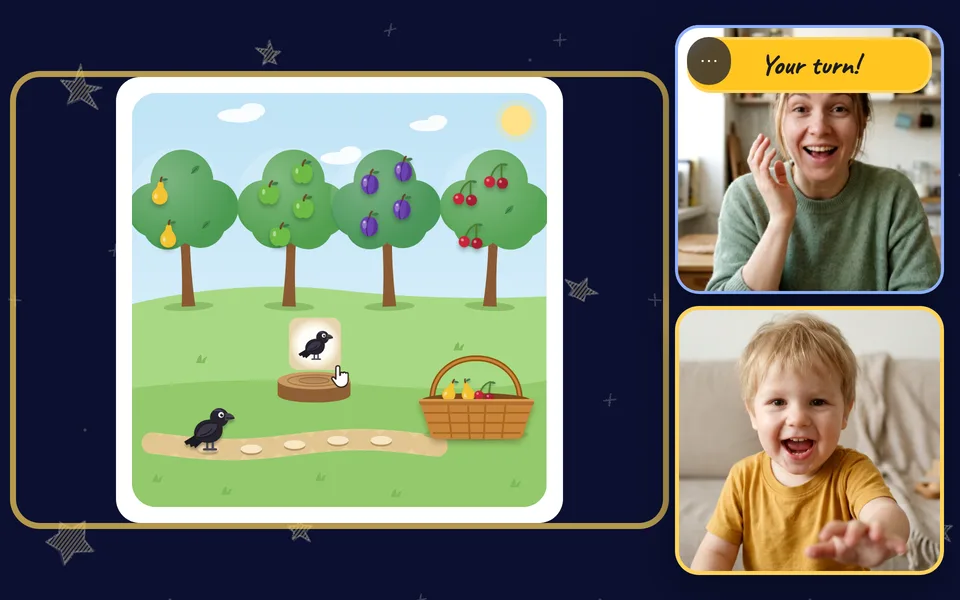
I'm building laketa for exactly these calls. Instead of "how are you?", you can draw together or play simple games, so your child has something to do with you, not just a screen to look at. Your child joins with one link, no app and no sign-up.
Sources accessed 2026-10-09. This article is not a substitute for advice from a pediatrician or psychologist.
Frequently asked questions
- Why does my toddler run away from video calls?
- It's typical for toddlers. In a survey of parents of children aged 16–30 months, two thirds said the conversation on video lasted less than 5 minutes, and half of the children sometimes ran off. A conversation with nothing to do together quickly gets boring for a toddler.
- Is a short video call with a toddler bad?
- There's no strict norm: with toddlers a call usually lasts a few minutes. In the survey by Strouse and colleagues, closeness and enjoyment of calls were linked to how often families called and how varied the activities were; call length was not studied.
- How do I hold a toddler's attention on a video call?
- Play games with an instant response (peekaboo, a song, "let's eat together"), ask your child to show you a toy and respond to what they showed, and switch activities instead of coaxing. The adult next to the child helps a lot.
- What if my child doesn't want to talk on video calls?
- Don't coax them back to the screen — follow them: ask the adult next to them to turn the phone and describe what your child is doing. And end the call yourself while your child is still interested.