
How to read to your child over a video call (no need to finish)
In short. You can read your child a story over a video call: the American Academy of Pediatrics names reading a book among its tips for calls. What matters is not finishing the book or asking the right questions, but looking at one book together: pointing, naming, letting your child turn the pages and stopping when they've had enough.
A bedtime story is one of the few rituals that moves easily into a call. But the first try often goes like this: you read to the camera with feeling, your child wanders off to their toys a minute later, and you finish “The Gingerbread Man” to an empty room. Here's how to make reading something you do together rather than a performance.
Can you read to a child over a video call
Yes. In its tips on video calls with babies and toddlers, AAP suggests tying the call to another activity — for example, having the loved one on the screen read the child a book. The same tips list reading books among activities for a call, alongside peekaboo, songs and games (AAP, March 24, 2026).
Families already do this. In a survey of 855 grandparents of children aged 0–5, 31% said they read to their grandchildren during video calls (Strouse et al., 2021).
In its guidelines for children under 5, WHO advises that when a child is sitting, they should have time with an adult — for example, reading and storytelling (WHO, 2019). WHO says nothing about video calls, though — more on that in “Video calls are not screen time”.
Should you ask your child questions about the book
There is a technique called “dialogic reading”: the adult doesn't just read but asks questions about the pictures and builds on the child's answers. It is often recommended as especially useful. When it was tested, the result was more modest.
A randomized study by Noble and colleagues included 150 children aged 2.5 to 3. For six weeks, parents were trained in one of two techniques — dialogic reading or reading with pauses. In a third group, parents also read actively with their children but without training in these techniques. Parents in the first two groups really did start reading differently, but their children's language did not grow more than in the third group (JSLHR, 2020).
What this does and doesn't mean:
- the study didn't compare reading with no reading, so it doesn't say reading is useless;
- it doesn't say questions do harm;
- it says that at 2.5–3 years, a special questioning technique added nothing beyond ordinary active shared reading.
For a call, the takeaway is simple: don't turn the story into a test. One or two questions per book is enough; the rest of the time, just read together.
How to read a book over a video call, step by step
What follows is advice from practice, not research findings.
- One book for both of you. It's easiest with two copies of the same book: one with you, one with your child. Then your child looks at their own copy, and you don't have to chase the page with the camera. If there's no second copy, hold the book close to the camera, open toward your child, and keep it still while they look. Tilt the page away from the lamp so the gloss doesn't glare.
- Point and name. “Here's a cat. The cat is sleeping. Where's the mouse?” For a 1–2 year old, a picture named out loud is already a whole story. You can retell the text in your own words.
- Your child turns the pages. If the book is with them, say “Turn the page!” and wait. If only you have the book, ask “Next?” That way your child decides when to move on.
- One or two questions, no more. “Who do you think the Gingerbread Man will meet?” — and accept any answer. Even better, respond to what your child has shown or said.
- Reread favorites. The twentieth “Enormous Turnip” isn't boring for a toddler: they know what comes next. Pause before a familiar word and let them say it.
- Stop when your child is done. Distracted, wandered off, brought a toy — close the book without regret and switch to what they brought.
Which books work for a call
The amounts in the table are a rough guide from practice, not a rule. Watch your child, not the page count.
| Age | What to read | How |
|---|---|---|
| 1–2 years | Board books with big pictures, nursery rhymes | Point and name, 1–3 spreads |
| 2–3 years | Short tales with repetition: “The Enormous Turnip”, “The Gingerbread Man”, “Goldilocks and the Three Bears” | Pause before a familiar word, your child finishes it |
| 3–5 years | Stories and poems of 5–10 spreads | One “what happens next?” question, a long book in parts, call to call |
If your child already reads on their own, switch roles: let them read to you.
What the adult next to your child can do
In their review, Strouse and colleagues cite a study by McClure and colleagues (2018): the more the whole family looked at the same thing during the call, the more attentive the baby was. Examples of this shared attention: a parent next to the child helps the grandmother on the screen read a book, or brings toys up to the screen (Strouse et al., 2021). AAP advises the adult next to the child to point at the screen and name what's happening there.
In practice, that means keeping the child's book open at the same page, pointing at the picture the parent is talking about and repeating: “Look, Dad is pointing at the bunny.” More in “How the adult next to your child makes a video call better”.
Why you don't have to finish
Calls with small children are short anyway, and wandering off from the screen is normal (there's a separate article on that: “Toddler runs away from video calls”). If you finish the book after your child has left, you're no longer reading to them.
An unfinished story isn't a failure. You were together over one book, and that's what matters. And the middle of the story is a ready-made start for the next call: “Tomorrow we'll find out who else the Gingerbread Man met.”
How laketa works
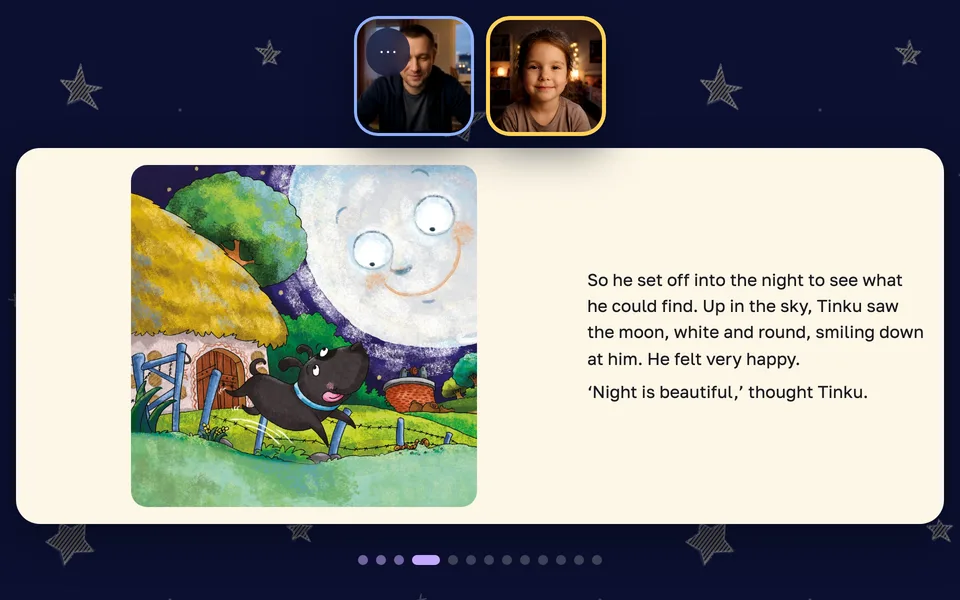
I'm building laketa for parents who call their children from far away. It has a Bedtime book: a picture book open on both screens — you read aloud, and the pages turn together. You can also hold your own book up to the camera or, if you're calling from a computer, show an e-book with screen sharing. After the story you can draw its hero together or play Orchard. Your child joins through one link, with no app and no sign-up, and there are no videos, feeds or ads on the call.
Sources accessed 2026-10-09. This article is not a substitute for advice from a pediatrician or psychologist.
Frequently asked questions
- Can you read a child a story over a video call?
- Yes. In its tips on video calls with babies and toddlers, the American Academy of Pediatrics suggests tying the call to a book and lists reading among activities for a call.
- How do I show a book on a video call so my child can see it?
- It's easiest to get two copies of the same book: one for you, one for your child. Without a second copy, hold the book close to the camera, open toward your child, keep it still and tilt it away from the lamp to avoid glare.
- Should I ask my child questions while reading?
- One or two are enough. In a study with children aged 2.5–3, a special questioning technique added no language gains beyond ordinary active shared reading.
- What if my child runs off in the middle of the story?
- Stop and switch to whatever they are doing. An unfinished story is not a failure but a ready-made start for the next call.
- What books should I read to a toddler over video?
- At 1–2, board books with big pictures and nursery rhymes; at 2–3, short tales with repetition like “The Enormous Turnip” or “The Gingerbread Man”; at 3–5, longer stories and poems, in parts. This is a guide from practice, not a rule.