
Are video calls screen time? What pediatricians and the WHO say
In short. The American Academy of Pediatrics (AAP) calls a young child's video call with family "relationship time," not screen time, and leaves video chat out of its advice to avoid screens before 18–24 months.
If you call your child from another city or country, you have probably heard it: "The phone again? He's not supposed to have screens." Sometimes it's the mom or grandma next to the child, sometimes it's your own conscience.
What the American Academy of Pediatrics says
The AAP is the main professional organization of pediatricians in the United States.
- 2016. In its official policy statement "Media and Young Minds," the AAP advises avoiding digital media for children younger than 18–24 months — except video chatting (Pediatrics, 2016).
- 2026. In its updated tips on video chatting with infants and toddlers, the AAP says it plainly: video chat is not screen time, it is "relationship time." Among the people for whom regular calls matter most, it names parents who live apart, parents who travel for work, and grandparents (AAP, March 24, 2026).
In the same tips, the AAP writes that at around 18–24 months a child begins to understand that the face on the screen is their real mom, dad or grandpa.
What the WHO says — and what it doesn't
The WHO's 2019 guidelines for children under 5 (press release):
| Age | Screen time according to the WHO |
|---|---|
| Under 1 | Not recommended |
| 1 year | Sedentary screen time is not recommended |
| 2–4 years | No more than 1 hour a day; less is better |
As examples of screen time, the WHO names watching cartoons on TV or devices, and video games. Video calls are not mentioned in the document at all — neither as allowed nor as forbidden. So you can't honestly say "the WHO allows video calls." You can say something else: the WHO limit is mostly about sitting in front of cartoons. And for the time a child spends sitting, the WHO itself recommends engaging with an adult — for example, reading stories together.
Why a live call is not a cartoon
A child only watches a cartoon. With a live person, even over video, the child interacts — and that is a different thing entirely.
- In an experiment by Roseberry, Hirsh-Pasek and Golinkoff (2014), children aged 24–30 months were taught new verbs. Over live video chat, where the adult responded to the child, they learned the words. From a recording of the same conversation, they did not (Child Development, 2014).
- In a study by Tarasuik, Galligan and Kaufman (2013), children aged 2 to 3.5 played more and showed more joy on a video call with a parent than on an ordinary phone call (Frontiers in Psychology, 2013).
A cartoon won't respond to your child. An adult on the screen will: they'll see the toy car, name it, show their own. That is the whole point.
What this means for your call
- Call without guilt. Pediatricians don't put a short live call with dad, mom or grandma in the same category as cartoons.
- Don't expect a long conversation. Video chat researchers cite a conference talk by Myers and McKenney (2021): two thirds of parents of children aged 16–30 months said their child talks on video for less than 5 minutes, and half said the child sometimes just runs off (Strouse et al., 2021). This is a conference talk, not a published study, but the picture is familiar. More in “Toddler runs away from video calls”.
- Respond to what your child is doing. They show you a toy — name it, ask about it, show yours. That is what live interaction means, and neither a cartoon nor even a video you recorded can give it.
- Turn off the background TV on your side and ask for it to be turned off on the child's side — this is direct AAP advice.
- Call at the same time each day — after breakfast or before dinner, it doesn't matter. What matters is that the call becomes a familiar ritual for your child. The AAP recommends a regular time and tying the call to something familiar: a meal, a book, a favorite toy.
If there is an adult next to your child
It helps them to know the sources too: the call is not "screen time" but time that pediatricians explicitly exclude from the limits. The AAP advises the adult next to the child to help: point at the screen, describe what is happening there, explain if the picture freezes. A short guide for that adult is in “How the adult next to your child makes a video call better”.
How laketa works
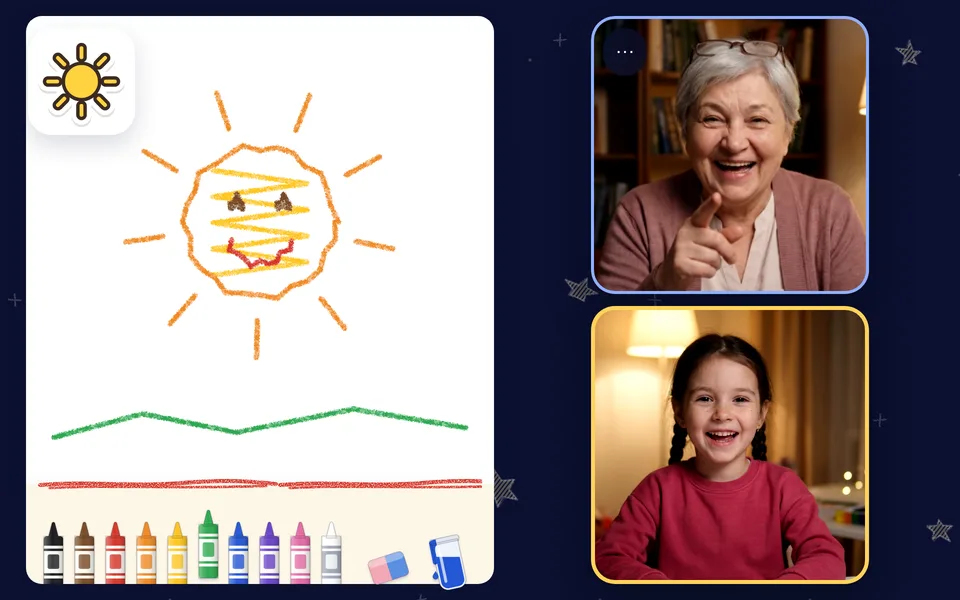
I'm building laketa for parents who call their children from far away. Your child opens one link — no app, no sign-up — and joins a call with no videos, no feed and no ads. You can draw together or play a simple game: your child doesn't just watch and listen but does something together with you.
Sources accessed 2026-10-09. This article is not a substitute for advice from a pediatrician.
Frequently asked questions
- Can a child under 2 video call?
- Yes. The American Academy of Pediatrics advises avoiding digital media before 18–24 months but explicitly excludes video chat. What matters is that the adult on the screen responds to the child and that an adult next to the child helps.
- Do video calls count as screen time under WHO guidelines?
- The WHO doesn't mention video calls. Its 2019 guidelines limit sedentary screen time and give cartoons and video games as examples. Screens are not recommended at all under age 1, and no more than an hour a day at ages 2–4.
- How long should a video call with a toddler last?
- There are no strict norms. In a survey of parents of children aged 16–30 months, two thirds said their child talks on video for less than 5 minutes. A short call in which you played together is a normal call.
- How is a live video call different from a cartoon?
- The adult responds to the child. In a 2014 experiment, children aged 2 to 2.5 learned new words over live video chat and did not learn the same words from a recording of the same conversation.