
What to say to your child on a video call: 12 phrases to try
In short. On a video call, a young child most often answers "how are you?" with silence or a single word: the question is abstract, and there is nothing to do with it. Phrases a child can answer with an action work better: a choice between two things, "show me," a comment on what the child is already doing, repeating their word and adding one new one. Below are 12 such phrases for children aged 1–8.
You call, your child appears on screen, and you ask what you would ask an adult: "Hi! How are you? What did you do today?" What you get back is "good," silence, or a back walking off toward the toys. Most often the problem is not you and not the call, but the question itself.
Why your child doesn't answer "how are you?"
To answer "how are you?", you have to remember the day, pick one thing out of it and put it into words. For a two-year-old that is hard; for a five-year-old it is boring. And a string of "What did you eat? Where did you go? What else?" turns the call into an interrogation, and the child leaves for somewhere with something to do.
Adults feel this too. In a review of research on family video chat, Strouse and colleagues cite a study in which grandparents of children aged 3–10 wanted to know the details of their grandchildren's lives but were afraid of annoying them with questions (Strouse et al., 2021).
What works instead of questions
Research has not tested specific phrases. It talks about what kind of adult on the screen keeps a child in the conversation:
- An adult who responds to the child. In an experiment by Roseberry, Hirsh-Pasek and Golinkoff, children aged 24–30 months learned new verbs in a live video chat where the adult reacted to them, but did not learn them from a recording of the same conversation (Child Development, 2014). The American Academy of Pediatrics (AAP) writes that toddlers can pick up new words over video, especially from an adult who smiles, responds and builds on what the child says (AAP, 2026).
- A shared object. When a child shows something through the screen or points at an object the adult is holding, it helps the little one stay in the call (McClure and colleagues, 2018, in the review by Strouse and colleagues). The same review mentions that grandparents liked video more than the phone: you can build the conversation around objects visible on screen.
Hence a simple rule: a question should lead to an action or an object, and the adult's response should go back to what the child just did. The phrases themselves are from practice: adapt them to your own child.
12 phrases for a video call with your child
The ages are a guide, not a boundary. Many phrases for toddlers work just as well with a five-year-old.
Ages 1–3: a choice, an action, one word
- 1. "Ball or teddy?" A choice between two instead of "what do you want to play?" It's enough for your child to point or bring one.
- 2. "Oh, you're building a tower. So tall!" A comment instead of a question. You name what your child is already doing, and they don't have to come up with anything to keep going.
- 3. Child: "Beep-beep!" You: "Beep-beep! The red car is driving." Repeat their word and add one or two of your own. Don't ask them to repeat after you and don't test them.
- 4. "I have a spoon. Where's your spoon?" An object "I have one — you have one." Finding one just like it is a clear task even for an 18-month-old.
- 5. "Peekaboo! Where's Mommy?… Here's Mommy!" Not a question in the usual sense, but children answer it with laughter and little hands. AAP explicitly names peekaboo, songs and toys among the activities for a video call.
If there is an adult next to your child, they can point at the screen and name what is happening — that is AAP advice too. A step-by-step script for a toddler is in the article “Video calls with a 1–2 year old: a 5-minute script”.
Ages 3–5: show me and find it
- 6. "Show me one thing you played with today." This is "how was your day," but answered with hands. One thing, not three: easy to choose.
- 7. "Find something round." A mini-task. Your child runs off screen, but with a purpose, and comes back with a find.
- 8. "Show me one funny move — I'll copy it." Your child leads, you copy. Then you can switch.
- 9. "Who's in charge today — your bunny or mine?" A choice in which your child runs the game.
- 10. "Will you show me your window, and I'll show you mine?" Two homes connect through one simple thing. Then you can compare: who can see a tree, who can see cars.
Ages 5–8: a story and an honest question
- 11. "What do you think happens next?" On a page of a book, halfway through a drawing, in a made-up story. Works from about age four. A drawing version: "Draw one line, and I'll guess what it turns into."
- 12. "Did anything fun happen today? And anything not so nice?" A specific question about feelings instead of a general "how are you?" If your child isn't in the mood to talk, give a choice: "Do you want to tell me about your day or show me something first?"
With a school-age child, a shared activity often works better than conversation — for example, let them read aloud to you.
What to say instead of the usual questions
| Instead of | Try |
|---|---|
| "How are you?" | "Show me one thing you played with" |
| "What did you do today?" | "Did anything fun happen today?" |
| "What color is the car?" | "Oh, you have a red car. Mine is blue" |
| "What do you want to play?" | "Ball or teddy?" |
| "Say: car" | "Yes, beep-beep! The car is driving" |
| "Come here, look at me" | Ask the adult nearby to turn the phone toward the child |
Test questions like "what color?" and "what does the cow say?" turn the call into an exam. Your child knows the answer, but answering isn't interesting.
You don't need to say all twelve phrases in one call. Two or three are enough, and a long program is the same interrogation, just a polite one. If your child still walks off screen, that is normal for their age — there is a separate article about it: “Toddler runs away from video calls”.
How laketa works
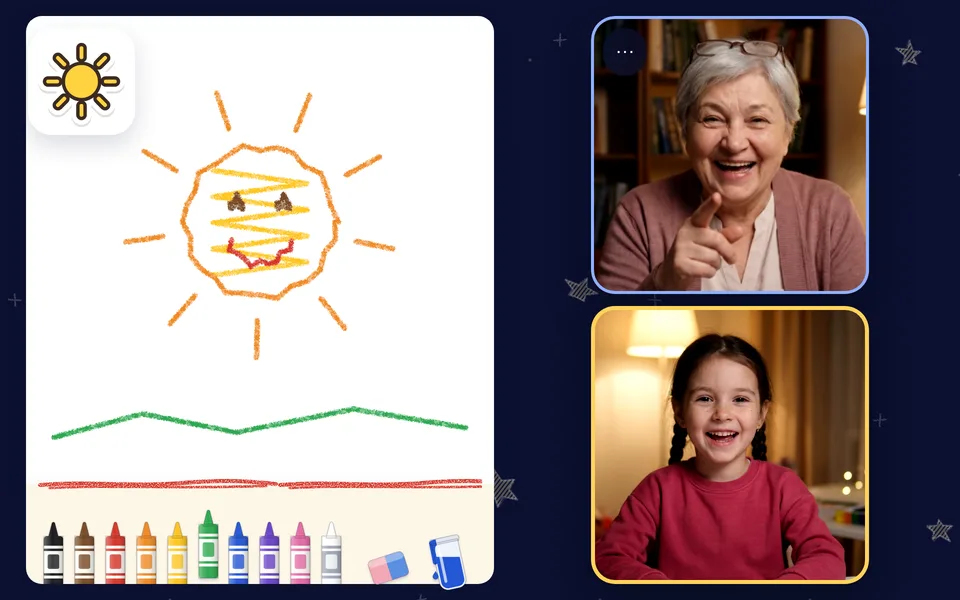
I'm building laketa for parents who call their children from far away. On the call you can draw together or play a simple game — then phrases like "what shall we draw?" or "your turn" have something to rest on. The child joins through one permanent link, with no app and no sign-up, and there are no videos, feeds or ads on the call.
Sources accessed 2026-10-09. This article is not a substitute for advice from a pediatrician or psychologist.
Frequently asked questions
- Why doesn't my child answer “how are you?” on video?
- The question is abstract: you have to remember the day, pick the main thing and put it into words. It is easier for a small child to answer with an action — show, choose, bring something.
- What should I talk about with a 2-year-old on a video call?
- Offer a choice of two (“ball or teddy?”), comment on what they are doing (“oh, you're building a tower”), repeat their word and add one of your own. This is advice from practice, not a research finding.
- What questions can I ask a 5–7-year-old on a video call?
- Specific ones, not general: “Did anything fun happen today? And anything not so nice?” or “What do you think happens next?” about a book or a drawing. You can offer a choice: talk about the day or show something first.
- Why is commenting better than asking questions?
- A comment responds to what the child is already doing and doesn't ask them to come up with an answer. In video chat studies, toddlers learned new words from an adult who responded to them, and showing objects through the screen helped them stay in the call.